


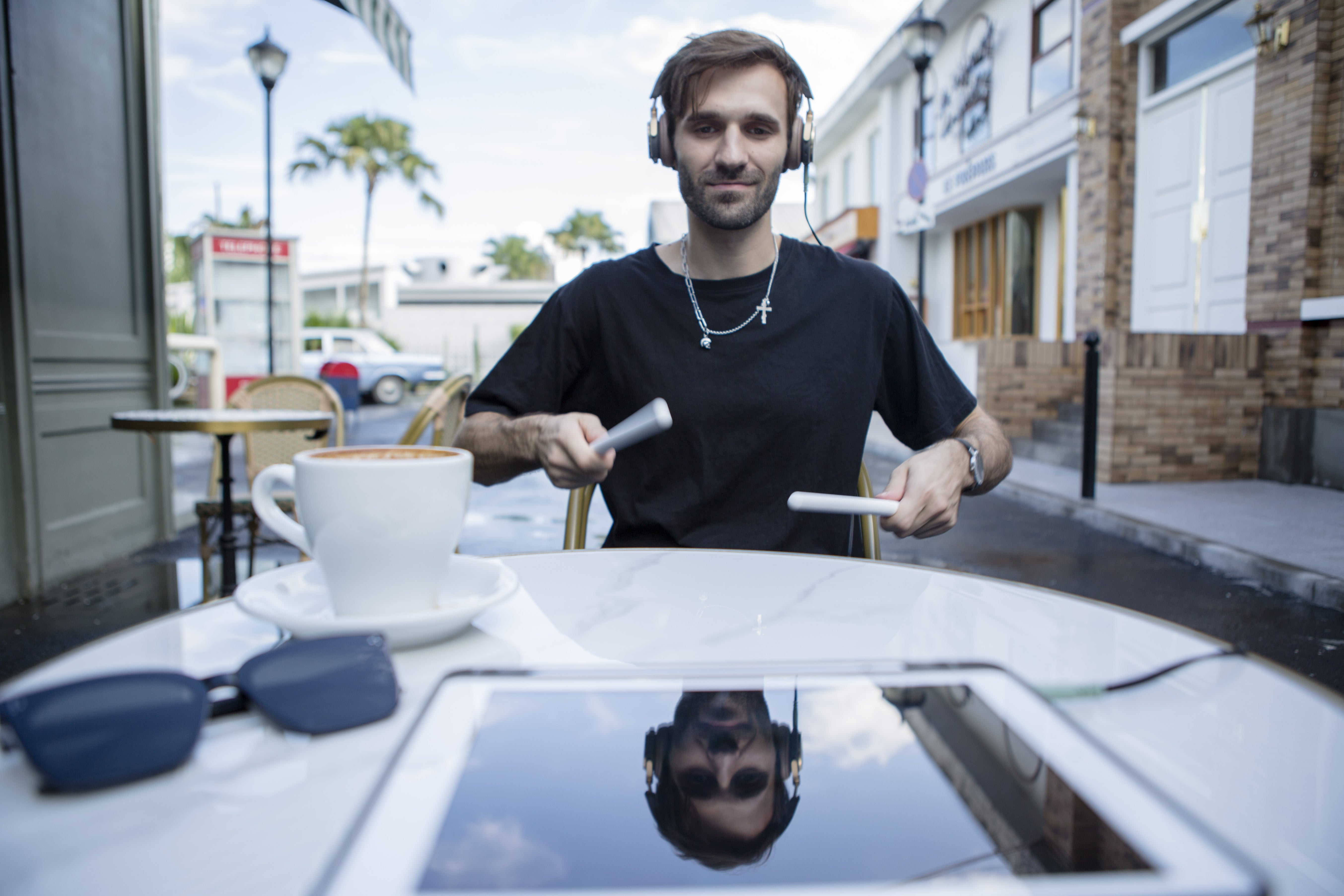
Mastering percussion requires consistency more than duration. For beginners and intermediates alike, a focused 15-minute daily session is often more effective than sporadic, marathon practices. With the advent of smart drumsticks and portable technology, this daily habit is easier to maintain than ever.
This guide outlines a high-efficiency workout designed to build muscle memory, timing, and coordination. By utilizing modern tools that mimic electric drums, players can perform these exercises anywhere, ensuring that fundamentals are never neglected due to noise constraints or lack of space.

The Evolution of Practice Tools
Traditionally, drummers were tethered to large, loud acoustic kits or stationary electric drums. This limitation often hindered daily practice, as setting up and finding a quiet time was difficult.
Smart drumsticks have revolutionised this dynamic. They utilize motion sensors and algorithms to replicate the physical experience of drumming without the bulk. This technology allows for an "air drumming" experience that is surprisingly accurate, translating movements into audio via headphones.
This portability means the "drum room" is now wherever the player stands. Whether in a living room, a hotel, or a break room, the barrier to entry for a quick 15-minute session has been removed.
Phase 1: The Warm-Up (Minutes 0-3)
The first three minutes are critical for preventing injury and establishing a connection between the mind and the hands. Jumping straight into complex rhythms with cold muscles can lead to strain.
Start with a basic Single Stroke Roll. This is the simple alternation of right and left hands (R-L-R-L). Begin at a slow, comfortable tempo. The goal here is not speed, but consistency. Ensure that every "hit" sounds at the same volume.
Focus on Grip and Posture
- Maintain a relaxed grip; tight hands kill rebound and speed.
- Keep shoulders low and relaxed, avoiding tension in the neck.
- Use the wrists for motion, not the entire arm.
Gradually increase the speed over the course of the three minutes, but back down immediately if tension builds. The objective is to get the blood flowing and the wrists loose.
Phase 2: Essential Rudiments (Minutes 3-8)
Once warmed up, the next five minutes focus on rudiments. These are the building blocks of all drumming vocabulary. Dedicating time to these patterns improves stick control and dexterity.
The Double Stroke Roll
Spend two minutes on the Double Stroke Roll (RR-LL). This rudiment is essential for playing smooth fills and intricate ghost notes. With smart drumsticks, focus on the clarity of the second note.
Beginners often let the second hit of the double stroke become weak. strive to make both taps equal in volume. This teaches the fingers to control the stick's rebound (or virtual rebound) effectively.
The Paradiddle
Spend the next three minutes on Single Paradiddles (R-L-R-R, L-R-L-L). This pattern combines single and double strokes, forcing the brain to switch between alternating hands and doubling up.
This rudiment is the key to moving around a drum kit fluidly. It allows the drummer to change direction without crossing their arms awkwardly. Practice this with a metronome or the built-in timing features of your app to ensure perfect spacing between notes.
Phase 3: Coordination and Grooves (Minutes 8-12)
After rudiments, shift focus to limb independence. This section simulates playing a full kit, engaging the feet alongside the hands. This is where the simulation of electric drums becomes most immersive.
The "Money Beat"
Practice a standard 4/4 rock beat. Play 8th notes on the hi-hat (right hand), beats 1 and 3 on the kick drum (right foot sensor), and beats 2 and 4 on the snare (left hand).
The challenge here is locking the limbs together. The kick drum and the hi-hat must land at the same millisecond on beat one. Smart drumsticks are excellent for this, as the audio feedback will instantly reveal if you are "flamming" (playing notes slightly out of sync).
Once comfortable, experiment with shifting the kick drum pattern. Move the kick to the "and" of beat 2 or 3. This forces the brain to separate what the right hand is doing from what the right foot is doing, a crucial skill for all drummers.
Phase 4: Creative Exploration (Minutes 12-15)
The final three minutes should be dedicated to free play and creativity. Discipline is important, but enjoyment keeps you coming back.
Exploring Sounds
Use this time to navigate through the app or module connected to your sticks. Switch from a standard rock kit to a jazz kit, or perhaps an electronic 808 set. Hearing a different drum sound can inspire different playing styles. A crisp funk kit might encourage tight, syncopated playing, while a booming rock kit might inspire heavy, simple grooves.
Freestyle Jamming
Let go of the strict counting and just play. Attempt to mix the rudiments practiced earlier into your grooves. Try to play a fill around the virtual toms and return to the groove on "one" without losing time. This segment solidifies the skills learned in the previous 12 minutes by applying them in a musical context.
Enhance the Experience with Technology
To maximize this routine, reliable gear is essential. You need tools that respond instantly to your movements to build accurate timing.
For a seamless experience, PocketDrum 2 Max offers ultra-low 6ms latency and MIDI functionality. These portable sticks allow you to play anywhere with double bass capabilities, ensuring a disturb-free practice session.
Consistency Over Intensity
The power of this 15-minute routine lies in its frequency. Doing this every day yields far better results than practising for two hours once a week.
Neurologically, the brain consolidates motor skills during sleep. By feeding the brain a small amount of focused data every day, you accelerate the learning process. You will find that movements which felt awkward on Monday feel natural by Friday.
To maintain this habit, stack it with another daily activity. Practice immediately after waking up, or right before dinner. The low friction of using smart sticks—removing the need to travel to a rehearsal space or set up heavy hardware—makes it much harder to find excuses to skip a day.
FAQ
Can smart drumsticks really replace a real drum set?
They are not a total replacement but are a powerful supplement. They are excellent for practising timing, coordination, and muscle memory when a real kit isn't available. They bridge the gap between air drumming and sitting at a physical set.
What is the difference between these and a standard electric drum kit?
Standard electric drums involve physical pads and a rack system. They take up space and create physical noise from hitting the rubber or mesh. Smart sticks rely on motion sensors, requiring no floor space and generating almost no ambient noise.
Do I need to know how to read music to use this routine?
No. The routine described above relies on patterns and listening. However, many apps associated with smart sticks include visual games that essentially teach you rhythm reading intuitively.
Is 15 minutes really enough to get better?
Yes. For fundamentals, short bursts of intense focus prevent mental fatigue and physical strain. It allows you to maintain peak concentration for the entire session, ensuring high-quality repetitions.
How do foot pedals work with smart drumsticks?
Most systems come with small sensors that clip onto your shoes or feet. When you tap your foot, the sensor detects the vibration and angle, triggering the sound of a bass drum or hi-hat pedal instantly.
Conclusion
Transforming your drumming skills does not require a soundproof studio or hours of free time. By dedicating just 15 minutes a day to this structured routine, you can build a professional foundation of rhythm and control.
Whether you are using a massive acoustic setup or a portable drum, electric drums like smart sticks, the principles remain the same. Warm up, practice your rudiments, work on coordination, and have fun. Start today, and the results will speak for themselves.


Share:
10 Easy Guitar Songs for Beginners
A Parent's Guide to the Best Christmas Gift for Young Drummers